
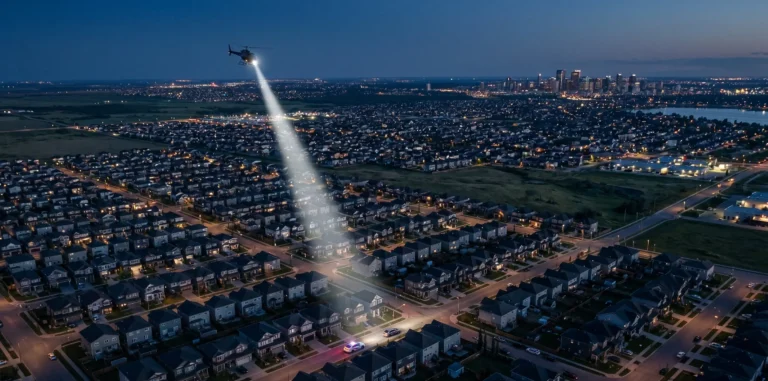
Flight from Police Charges in Alberta: What You're Actually Facing
Legal Review By: Brad Kraus, Criminal Defence Lawyer, KJR Law
Last Updated: June 8, 2026
Flight from a peace officer is a serious indictable-eligible offence in the modern transportation framework of the Criminal Code. Created in its current form by the comprehensive 2018 transportation amendments, the offence captures the act of operating a motor vehicle or vessel while being pursued by police and failing, without reasonable excuse, to stop. The Crown does not have to prove a collision, bodily harm, intoxication, or any underlying offence — the conduct of failing to stop while under pursuit is itself the offence. The maximum sentence on indictment is ten years' imprisonment. Where the flight results in bodily harm or death, additional charges layered on top can take the sentencing exposure substantially higher.
This page explains section 320.17 of the Criminal Code and its statutory neighbours, the elements the Crown must prove, the sentencing framework under s. 320.19 and the aggravating factors at s. 320.22, conditional sentence availability under s. 742.1 following Bill C-5, the discretionary federal driving prohibition under s. 320.24 and the parallel automatic provincial disqualification under Alberta's Traffic Safety Act (with its consecutive-stacking rule), and the Charter and substantive defences that engage in modern flight files. KJR Law represents people facing flight from police charges across Calgary and Southern Alberta.
Do Not Give a Statement Before You Speak with a Lawyer
Flight files often produce the strongest temptation to explain. The driver who panicked, who did not realise the unmarked vehicle was police, who had a passenger threatening them, who was certain they had been signalled to a particular location to stop — each version is the kind of "context" investigators expect to hear, and each becomes admissible evidence at trial. The right to remain silent under s. 7 of the Canadian Charter of Rights and Freedoms and the right to retain and instruct counsel without delay under s. 10(b) apply at the moment of arrest. The roadside is not the time to put the explanation on the record. Call a lawyer first. If a statement should follow, it can be prepared properly.
The Section 320.17 Framework
The offence is defined in plain terms at s. 320.17 of the Criminal Code:
Everyone commits an offence who operates a motor vehicle or vessel while being pursued by a peace officer and who fails, without reasonable excuse, to stop the motor vehicle or vessel as soon as is reasonable in the circumstances.
The Crown must prove four elements beyond a reasonable doubt:
- Operation of a motor vehicle or vessel. The offence applies to vehicles and vessels — not to bicycles, pedestrians, or persons under arrest who flee on foot. The definition of "motor vehicle" in s. 2 and the related definitions in Part VIII.1 of the Code govern.
- While being pursued by a peace officer. The officer must actually have been in pursuit. Where the police vehicle had not activated emergency equipment, where the pursuit was not visible to the accused, or where the police had ceased to pursue, the element is open to argument.
- Failure to stop as soon as is reasonable in the circumstances. Not "immediately" — "as soon as is reasonable." Driving a short distance to a well-lit area before stopping, completing a safe lane change before pulling over, or reaching a designated truck pull-off can all be reasonable in their circumstances.
- Without reasonable excuse. A statutory excuse is built into the offence. Genuine fear for safety, an emergency en route to a hospital, mechanical failure that prevented a safe stop, or a credible reason not to stop in a particular location can all engage the reasonable excuse defence.
Knowledge is the implicit fifth element. The accused must have been aware of the pursuit, or wilfully blind to it. The Alberta Court of Appeal in R v Kulchisky, 2007 ABCA 110 recognised — on the predecessor offence at s. 249.1 — that the offence requires deliberate awareness on the part of the accused that police were attempting to stop them. The framework was carried forward to s. 320.17 in R v Russell, 2023 BCSC 1123, which held that the actus reus is complete when the accused fails to stop after the officer engages emergency equipment, and that the mens rea requires the accused was deliberately, or wilfully blind to, the pursuit. Where the police vehicle was unmarked and operating without emergency equipment, where conditions limited visibility, where the accused was a brief distance ahead of a cruiser they did not perceive as being in pursuit, the knowledge element is litigable.
Penalties Under Section 320.19
The penalty framework for flight is set at s. 320.19 of the Criminal Code:
- On indictment: imprisonment for a term not exceeding 10 years (s. 320.19(5)(a)).
- On summary conviction: the offence is "punishable on summary conviction" under s. 320.19(5)(b), with the maximum imprisonment governed by s. 787 of the Code — currently two years less a day following Bill C-75.
There is no mandatory minimum custodial sentence for s. 320.17 standing alone. The maximum penalty applies to the flight offence itself. Where bodily harm or death has resulted from the operation, the Crown will typically lay additional charges — most commonly dangerous operation causing bodily harm under s. 320.13(2) (maximum 14 years on indictment), dangerous operation causing death under s. 320.13(3) (maximum life), or criminal negligence offences under ss. 219 to 221 of the Code. The cumulative exposure on the combined charges can be substantially higher than the flight maximum on its own.
Conditional Sentences and Section 742.1 — Post-Bill C-5
A conditional sentence served in the community is available on a conviction under s. 320.17 of the Criminal Code. The offence carries no mandatory minimum (so the s. 742.1(b) exclusion does not engage), it is not one of the offences enumerated in s. 742.1(c) (attempt to commit murder under s. 239(1)(b), torture under s. 269.1, advocating genocide under s. 318), and it is neither a terrorism offence nor a criminal organization offence (so s. 742.1(d) does not apply). None of the statutory exclusions in s. 742.1 close the door on a CSO for a flight from peace officer conviction.
Section 742.1 as amended by Bill C-5 (in force November 17, 2022) was the legislative response to a fifteen-year contraction in CSO availability that began with the Tackling Violent Crime Act and was extended by the Safe Streets and Communities Act. Bill C-5 repealed the broad exclusions in the former paragraphs (e) and (f) and restored CSO availability for a large group of offences that previously could not attract a community-based sentence. Flight from peace officer is one of them.
Whether the sentencing court grants a CSO in a particular flight file remains discretionary. The court must impose a sentence of less than two years, must be satisfied that service of the sentence in the community would not endanger the safety of the community, and must be satisfied that a CSO would be consistent with the fundamental purpose and principles of sentencing in ss. 718 to 718.2. The aggravating factors at s. 320.22 are central to that analysis. In a file where none of the s. 320.22 aggravators are present — no bodily harm or death, no race or speed contest, no passenger under sixteen, no remunerated operation, no high blood alcohol concentration, no large vehicle, no operation while prohibited — and where the underlying pursuit was brief or contextually explicable, the negotiating space for a CSO is meaningfully open. Where multiple aggravators are made out, custody becomes more likely. Sentencing advocacy on the s. 320.22 factors and the s. 718.2(e) restraint principle for Indigenous offenders are core defence work in any flight file headed to sentencing.
The Statutory Aggravating Factors — Section 320.22
Section 320.22 lists the statutory aggravating factors that a sentencing court must consider on any offence under ss. 320.13 to 320.18, including s. 320.17 flight. These factors are routinely the focus of Crown sentencing submissions and are often where files are won or lost at the sentencing stage:
- The offence resulted in bodily harm to or the death of more than one person;
- The offender was operating a motor vehicle in a race with at least one other motor vehicle, or in a contest of speed, on a street, road or highway or in another public place;
- A person under the age of 16 was a passenger in the conveyance operated by the offender;
- The offender was being remunerated for operating the conveyance;
- The offender's blood alcohol concentration at the time of the offence was equal to or exceeded 120 mg of alcohol in 100 mL of blood;
- The offender was operating a large motor vehicle;
- The offender was not permitted, under a federal or provincial Act, to operate the conveyance.
Where one or more of these factors apply, the sentencing trajectory of the file tilts toward custody. Where they do not, the negotiating space for community-based dispositions is more open. Identifying — and, where possible, contesting — the factual basis for each alleged aggravator is core defence work at sentencing.
Federal Driving Prohibition Under Section 320.24
A conviction under section 320.17 of the Criminal Code triggers a discretionary federal driving prohibition under section 320.24(4). The sentencing court "may" make a prohibition order. There is no minimum prohibition period prescribed by the Criminal Code for this offence. The mandatory prohibition framework under s. 320.24(1) — with its one-, two-, and three-year minimums for first, second, and subsequent offences — applies only to impaired operation under s. 320.14(1) and refusal under s. 320.15(1). It does not apply to flight from peace officer, dangerous operation, failure to stop, or any of the other offences captured by s. 320.24(4).
The maximum prohibition period under s. 320.24(5) is calibrated to the maximum prison sentence available for the offence of conviction. For s. 320.17 flight prosecuted on indictment, the prohibition can run up to ten years, plus the entire period to which the offender is sentenced to imprisonment (s. 320.24(5)(b)). For s. 320.17 prosecuted summarily, the maximum prohibition is three years on the same "plus imprisonment" basis (s. 320.24(5)(c)). Where the flight charge is companioned by dangerous operation causing bodily harm under s. 320.13(2), or failure to stop after an accident causing bodily harm under s. 320.16(2), the same ten-year maximum applies to a prohibition tied to those convictions — each carries a fourteen-year indictable maximum, which engages s. 320.24(5)(b). Where the companion charge is dangerous operation causing death under s. 320.13(3) or failure to stop after an accident causing death under s. 320.16(3), the prohibition period under s. 320.24(5)(a) is "any duration that the court considers appropriate," reflecting the life-imprisonment maximum for those offences.
One limit on the federal prohibition is worth noting. The s. 320.24(4) power reaches only the conveyance offences it enumerates — dangerous operation, failure to stop, flight, and operation while prohibited. It does not extend to a conviction for criminal negligence causing death under s. 220 or criminal negligence causing bodily harm under s. 221, even where the offence was committed by means of a motor vehicle. In R v Wolfe, 2024 SCC 34, the Supreme Court of Canada held that those offences are not among the offences listed in s. 320.24, so no federal driving prohibition is available on a standalone criminal-negligence conviction. The provincial five-year disqualification under s. 87(3) of the Traffic Safety Act, set out below, applies to those offences regardless.
Because the federal prohibition is discretionary, defence sentencing submissions can engage that discretion — on whether a prohibition is necessary in the circumstances at all, on its length, and on its relationship to any concurrent provincial disqualification. That advocacy space is one of the meaningful values of careful sentencing work in a flight from police file.
The federal discretion is, however, undercut by the provincial reality that follows. The second consequence — the automatic provincial disqualification under Alberta's Traffic Safety Act, which operates by force of statute rather than by court order — is set out below.
The Parallel Provincial Disqualification Under the Traffic Safety Act — and the Consecutive Stacking Rule
Alberta's Traffic Safety Act imposes its own automatic disqualification, running alongside any federal prohibition imposed, on every conviction for flight from peace officer and a series of related conveyance offences. The provincial disqualification is automatic. It does not require a separate court order. It does not turn on submissions at sentencing. It takes effect on the day of the finding of guilt.
Section 87(1) — one-year automatic provincial disqualification. Section 87(1) of the Traffic Safety Act provides that a person found guilty anywhere in Canada under s. 320.13(1) (dangerous operation), s. 320.16(1) (failure to stop after accident), or s. 320.17 (flight from peace officer) of the Criminal Code is, on being found guilty, automatically disqualified from driving a motor vehicle in Alberta for one year from the day of the finding of guilt. For a conviction under s. 320.17 alone — flight without bodily harm or death — the automatic provincial disqualification is one year.
Section 87(2) — five years for the bodily-harm and death variants. Where the conviction is for the more serious variants of these offences — s. 320.13(2) or (3), s. 320.14(2) or (3), s. 320.15(2) or (3), or s. 320.16(2) or (3) — s. 87(2) of the Traffic Safety Act extends the automatic disqualification to five years.
Section 87(3) — five years for criminal negligence and motor-vehicle manslaughter. A conviction under s. 220 (criminal negligence causing death), s. 221 (criminal negligence causing bodily harm), or s. 236 (manslaughter) of the Criminal Code, where the offence was committed by means of a motor vehicle, triggers a five-year automatic provincial disqualification under s. 87(3).
Section 98 — disqualifications run consecutively, not concurrently. This is the feature of the Alberta scheme that surprises most accused persons. Section 98(1) of the Traffic Safety Act applies where a person already disqualified from driving in Alberta picks up a further disqualification during that period — either under TSA s. 94 (the disqualification that attaches to driving while unauthorized, that is, driving while already suspended or disqualified) or anywhere in Canada under s. 320.24 of the Criminal Code (a federal driving prohibition); that second disqualification runs consecutively to any previous disqualification that is still in effect or waiting to go into effect. Section 98(2) extends the same consecutive rule to any other second Alberta disqualification arising during an active one — most importantly, the automatic disqualifications under s. 87(1), (2), and (3) themselves, where they would otherwise overlap with another active disqualification.
The practical consequence is that a person already serving any active driving disqualification — whether from an administrative suspension, an earlier impaired-driving conviction, or a previous flight conviction — who is then convicted of a new s. 320.17 offence does not have the new disqualification absorb into the existing one. The new disqualification stacks on top, starting only after the existing period has expired. The two periods of disqualification add together rather than overlap. A person who was, for example, six months into a one-year disqualification at the time of a new s. 320.17 finding of guilt is looking at a total off-road period that is longer than either disqualification standing alone would have produced.
How the federal and provincial schemes interact in practice. A flight conviction typically produces three intersecting driving consequences: any federal driving prohibition the sentencing court chooses to impose under s. 320.24(4) of the Criminal Code; the automatic provincial disqualification under s. 87 of the Traffic Safety Act; and, where any prior disqualification was still active at the time of the new finding of guilt, the consecutive-stacking rule under s. 98 of the Traffic Safety Act. For a person without any active prior disqualification, the federal and provincial periods generally run alongside each other from the date of conviction. For a person with an active prior disqualification, the periods stack. Counsel needs to map all of this out from the first conversation — the total off-road period a client is actually facing is often considerably longer than the federal prohibition figure on its own suggests.
Companion Charges
Flight from police is rarely the only charge on the information. The pursuit that precedes a s. 320.17 charge typically begins with another offence — and the flight charge sits alongside the underlying matter. Common companion charges include:
- Dangerous operation — s. 320.13, where the driving during the pursuit meets the dangerous operation threshold;
- Impaired operation — s. 320.14, where the accused was over 80 mg/100 mL or impaired;
- Operation while prohibited — s. 320.18, where the accused was already subject to a driving prohibition;
- Failure to stop after accident — s. 320.16, where a collision occurred during the pursuit;
- Possession of stolen property — s. 354, where the vehicle was stolen or contained stolen property;
- Possession of a weapon or firearms offences — where weapons were found in the vehicle on search;
- Drug offences under the Controlled Drugs and Substances Act — where controlled substances were found on the search incident to arrest;
- Breach of conditions — s. 145, where the conduct breached release conditions or a probation order.
The Defences That Actually Work
Flight files reward careful work on each element and on the underlying police investigation:
Knowledge of the pursuit. Did the accused actually know they were being pursued? Per R v Kulchisky and R v Russell (above), the Crown must prove the accused was deliberately, or wilfully blind to, the pursuit — mere objective foreseeability is not enough. Where the police vehicle was unmarked, where emergency equipment was not consistently activated, where weather or visibility limited the accused's perception, where the time between the activation of lights and the alleged failure to stop was short, the knowledge element is open to argument. The dash-cam and in-car video record on the police side is usually the determinative piece of evidence here — and it is fully reviewable on disclosure.
Reasonable excuse. The statute builds reasonable excuse into the elements of the offence. Genuine, contemporaneous concerns about personal safety, a passenger's safety, or roadside conditions can support a reasonable excuse defence. Courts have recognised that drivers can take a short distance to reach a well-lit or populated area before stopping, particularly during night-time or remote-area stops.
Reasonable time and circumstances. The statute requires a failure to stop "as soon as is reasonable in the circumstances" — not immediately, not in the next car-length. Stops delayed by traffic conditions, road geometry, weather, mechanical limitations, or genuine search for a safe pulling-over location can be reasonable. Where the police pursuit lasted only seconds before the accused stopped, the element is open to argument.
Charter section 8 — search and seizure. Vehicle searches following a flight arrest are reviewable on Charter grounds. Where the search was authorized by warrant, the procedural framework for challenging that authorization is set by R v Garofoli, [1990] 2 SCR 1421. Warrantless searches engage the search-incident-to-arrest framework and require a lawful arrest grounded in reasonable and probable grounds. Where companion charges (drugs, firearms, stolen property) depend on the products of the search, Charter litigation on s. 8 can collapse those charges and substantially reduce the file's exposure.
Charter section 9 — arbitrary detention. Where the initial detention or attempted stop was without lawful authority — for example, where the officer had no reasonable suspicion of an offence under R v Mann, 2004 SCC 52, or no objective grounds for a Traffic Safety Act stop under R v Ladouceur, [1990] 1 SCR 1257 — the detention is reviewable. An arbitrary detention engages exclusion of derivative evidence under s. 24(2) of the Charter.
Charter section 10(b) — right to counsel. Statements taken roadside or at the detachment without proper rights advice, or before the accused had a reasonable opportunity to consult counsel, are vulnerable. R v Grant, 2009 SCC 32 governs the admissibility analysis.
Identification. Where the vehicle did not stop and the driver was identified later — by registration of the vehicle to the accused, by witness identification, by pursuit video that did not clearly capture the driver — identification can be contested. Multiple occupants, shared vehicle use, recent purchase, and other facts can leave reasonable doubt on identification.
Vehicle Seizure and Insurance Consequences
Beyond the licensing track, flight files in Alberta routinely involve seizure of the vehicle and significant insurance fallout. Police typically seize the vehicle as evidence and as the instrumentality of the offence at the point of arrest. Provincial vehicle impoundment under the Traffic Safety Act can run alongside the criminal seizure. Recovery of a seized vehicle during the proceeding is sometimes possible but is often complicated by the parallel provincial process. Insurance consequences — substantially elevated premiums, non-renewal, or, in serious files, the practical loss of standard-market coverage and a forced shift to the Facility Association at considerable annual cost — typically follow any criminal driving conviction and frequently follow the charge alone. Over five to seven years, the insurance fallout often exceeds the direct legal costs of defending the file. Counsel needs to manage the criminal, licensing, vehicle, and insurance tracks together from the first conversation.
Where We Appear
We act on flight from police and related driving files in the Alberta Court of Justice, the Court of King's Bench of Alberta, and the Court of Appeal of Alberta. From our Calgary office we travel to court in Airdrie, Cochrane, Canmore, Okotoks, Diamond Valley, Didsbury, Strathmore, Drumheller, Hanna, Brooks, Medicine Hat, Lethbridge, Fort Macleod, Taber, Pincher Creek, and Cardston, and we appear in matters arising on the Tsuut'ina, Siksika, and Kainai (Blood Tribe) Nations.
If You Have Been Charged, Call a Lawyer Today.
Flight files reward early engagement. The video and audio evidence on the police side is the strongest evidence the Crown will have, and the earlier counsel can review it the better placed the defence is to identify the Charter and substantive issues. The provincial licensing and insurance consequences run on a parallel track that counsel needs to manage alongside the criminal proceeding.
Call us today at 587-583-2808
Strictly confidential. Initial consultation at no charge.
Flight from Police Defence FAQ
Do I have to have been driving at high speed to be convicted of flight from police?
No. Speed is not an element of s. 320.17 of the Criminal Code. The offence focuses on whether the accused knowingly failed to stop as soon as was reasonable in the circumstances, without reasonable excuse, while being pursued. A low-speed failure to stop can support the charge. Speed becomes relevant at the sentencing stage and in any companion dangerous operation charge under s. 320.13.
What if I did not realise police were trying to stop me?
Knowledge of the pursuit is fundamental to the offence. The Crown must prove the accused knew they were being pursued by police. Where the police vehicle was unmarked, where the emergency equipment was not consistently activated, where conditions limited visibility, or where the pursuit had not yet been signalled at the moment of the alleged failure to stop, the knowledge element is open to argument. Police in-car video is usually the determinative evidence on this point and is fully reviewable on disclosure.
What if I was scared and waited until I was somewhere safe to stop?
The statute requires a failure to stop "as soon as is reasonable in the circumstances," and "without reasonable excuse." Courts have accepted that drivers can take a short distance — to reach a well-lit area, a populated location, an exit ramp, or a designated pull-off — particularly at night or in remote areas. The reasonable excuse defence is fact-specific and is most likely to succeed where the delay was short, purposeful, and supported by the circumstances.
Can I be charged with flight from police even if no one was hurt?
Yes. Section 320.17 is not a results-based offence. The Crown does not have to prove a collision, bodily harm, property damage, or any other consequence. Where harm has resulted, the Crown will typically lay additional charges under s. 320.13(2) (causing bodily harm), s. 320.13(3) (causing death), or the criminal negligence provisions, with substantially higher sentencing exposure.
What if the police could not see who was driving?
Identification is a live issue whenever the vehicle did not stop and the driver was identified only after the fact. The Crown still has to prove beyond a reasonable doubt that the accused was the person driving. Registration of the vehicle to the accused is not proof that the accused was behind the wheel. Where the pursuit video did not clearly capture the driver, where the vehicle had multiple occupants, where it was shared among family members or recently purchased, or where the identification rests on a fleeting or obstructed observation, the identification element can be contested. These files turn on the quality of the Crown's identification evidence, which is fully reviewable on disclosure.
Can the police search my car after a flight arrest?
Not without legal authority. A vehicle search following a flight arrest must be justified — either by a warrant or under the search-incident-to-arrest power, which requires a lawful arrest grounded in reasonable and probable grounds. Where the search was authorized by warrant, the authorization can be challenged under the framework in R v Garofoli. Where it was warrantless, the Crown must justify it. This matters because flight charges often travel with companion charges — drugs, weapons, or stolen property — that depend entirely on what the search turned up. A successful challenge under s. 8 of the Charter can lead to exclusion of that evidence under s. 24(2) and can collapse the companion charges, substantially reducing the file's exposure.
What other charges usually come with a flight from police charge?
Flight is rarely charged on its own. A pursuit usually begins with something else, so the flight count typically sits alongside the underlying matter. Common companions include dangerous operation under s. 320.13, impaired operation under s. 320.14, operation while prohibited under s. 320.18, and failure to stop after an accident under s. 320.16. Where the vehicle was stolen, possession of stolen property under s. 354 can be added; where weapons or controlled substances were found on the search, firearms charges or drug charges under the Controlled Drugs and Substances Act may follow; and where the conduct breached a release order or probation, a breach charge under s. 145 is common. The companion charges often drive the overall exposure more than the flight count itself.
Will my vehicle be seized?
In most flight files, yes — at least initially. Police routinely seize the vehicle as evidence and as the instrumentality of the offence. Provincial vehicle impoundment under the Traffic Safety Act can run alongside the criminal seizure. Recovery of a seized vehicle is sometimes possible during the proceeding but is often complicated by the parallel provincial track and by the ongoing criminal investigation.
Will I lose my licence?
Almost certainly, in stages. On conviction, two separate driving consequences attach. The federal prohibition under s. 320.24(4) of the Criminal Code is discretionary — the Criminal Code sets no minimum period for a flight conviction — but the sentencing court can impose a prohibition of up to three years on a summary conviction and up to ten years on an indictable conviction (s. 320.24(5)(b)–(c)). The provincial automatic disqualification under s. 87(1) of Alberta's Traffic Safety Act imposes a one-year disqualification on the same day. Where bodily harm or death is involved, or where companion ss. 220 / 221 / 236 charges are made out, the provincial disqualification under s. 87(2) or (3) extends to five years. And where a person is already serving any other driving disqualification at the time of the new finding of guilt, s. 98 of the Traffic Safety Act stacks the new disqualification consecutively — under s. 98(1) where the new disqualification is a federal prohibition under s. 320.24 of the Criminal Code or a TSA s. 94 disqualification, and under s. 98(2) for other Alberta disqualifications. The periods add rather than overlap. The total off-road period a person is actually facing can be substantially longer than the federal prohibition imposed by the criminal court would suggest standing alone.
Can I avoid jail on a flight from police charge?
Outcomes depend on the circumstances of the pursuit, whether any of the s. 320.22 aggravating factors apply, the strength of the Crown's evidence, the success of any Charter applications, the prior criminal and driving record of the accused, and the resolution path identified. Following Bill C-5 (in force November 17, 2022), conditional sentences served in the community are available on a s. 320.17 conviction — none of the statutory exclusions in s. 742.1 close that door. Suspended sentences with strict probation conditions and custodial sentences are also available depending on the file. Where the pursuit was prolonged, involved high speed, or placed others at significant risk, custody is more likely. Where the pursuit was brief and the s. 320.22 factors are not present, community-based dispositions are more open.
Will this affect my insurance?
Yes. Criminal driving convictions trigger substantial premium increases or non-renewal with most Alberta insurers, often to the point where coverage becomes available only through the Facility Association at considerable cost. The insurance consequences frequently follow the charge alone, even before conviction. The financial impact over five to seven years can exceed the direct costs of the criminal proceeding.
What does KJR Law charge to defend a flight from police file?
Fees depend on the seriousness of the charge, the presence of companion charges, whether Charter applications under ss. 8, 9, or 10 are required, the volume of video disclosure, and whether the matter resolves before trial or proceeds to trial. We set out our fee, disbursements, and GST in a written retainer letter before any work begins. The initial consultation is at no charge.
The First Conversation Is Free.
Flight files reward careful work on the police video record, on the knowledge element, on the reasonable excuse and reasonable time analysis, and on the Charter issues that frequently attach to the search incident to arrest. Early engagement gives counsel the time to review the disclosure while it is fresh and to manage the criminal, licensing, and insurance tracks together.