
Impaired Driving Charges in Alberta: What You're Actually Facing
Legal Review By: Brad Kraus, Criminal Defence Lawyer, KJR Law
Last Updated: June 6, 2026
Impaired driving in Alberta runs on two parallel tracks. The first is the federal criminal track under section 320.14 of the Criminal Code — the offence that produces a criminal record, a federal driving prohibition, and the lifelong consequences that follow a criminal conviction. The second is the provincial administrative track under Alberta's SafeRoads program — the Immediate Roadside Sanction (IRS) system, which produces a vehicle seizure, an automatic driving suspension, and (for the most serious IRS-FAIL category) a 12-month interlock requirement, but no criminal record. Most files involve only one track. Some involve both. And many people who think they have been "charged with DUI" have actually received only an IRS — an entirely administrative matter where the path to challenge runs through SafeRoads Alberta, not the criminal courts.
This page explains the criminal impaired driving framework — section 320.14 of the Criminal Code, the mandatory alcohol screening regime under s. 320.27, the approved instrument demand framework under s. 320.28, the mandatory minimum penalties scaled to BAC under s. 320.19, the mandatory federal driving prohibition under s. 320.24, the provincial driving consequences under Alberta's Traffic Safety Act — the automatic disqualifications under s. 87, the alcohol-sensing-device requirement under s. 88.2, and the consecutive-stacking rule under s. 98 — and the modern defences in the wake of R v Breault, 2023 SCC 9. If your matter is administrative — an IRS only, with no criminal charge — the path is set out on our SafeRoads Alberta IRS appeal page. KJR Law represents people facing impaired driving charges and IRS reviews across Calgary and Southern Alberta.
Do Not Give a Statement Before You Speak with a Lawyer
The distinction between what police can compel and what they cannot is more nuanced than most roadside advice suggests. A lawful breath demand under s. 320.27 or s. 320.28 of the Criminal Code is a compelled physical act — refusal is itself a criminal offence under s. 320.15, carrying the same mandatory minimums as impaired operation itself. But the questions surrounding the demand — "Where are you coming from?" "How much have you had to drink?" "What did you have?" — are investigative questions that you are not required to answer. Statements made in response to those questions become the grounds for arrest and the foundation of the Crown's case at trial.
The practical advice. Comply with the lawful breath demand. Provide the sample when the approved screening device or approved instrument is properly produced. Beyond that, exercise the right to remain silent under s. 7 of the Canadian Charter of Rights and Freedoms and the right to retain and instruct counsel without delay under s. 10(b). Politely state that you would like to speak with a lawyer before answering questions. The investigation, the bail process, and the prosecution all proceed more cleanly when the accused has not made admissions that the Crown would otherwise have to prove circumstantially.
Criminal Charge or IRS? — Understanding Which Track You're On
Before going further it's worth establishing which track your matter is actually on. Many people who land here looking for "DUI defence" or "impaired driving lawyer" have not been criminally charged — they have received an administrative sanction under Alberta's SafeRoads program. The two tracks have entirely different procedures, decision-makers, evidentiary standards, and consequences.
The criminal track — section 320.14 of the Criminal Code. If you have been charged criminally, you will have received documentation either at the roadside or following arrest indicating that you are charged under the Criminal Code. You will be required to attend court. You face a criminal record on conviction, a mandatory federal driving prohibition under s. 320.24, mandatory minimum penalties under s. 320.19, and significant collateral consequences (immigration, employment, US travel). This is the track this page primarily addresses.
The IRS track — Alberta's SafeRoads program. If your matter is an Immediate Roadside Sanction — an IRS-FAIL (BAC over 80 mg/100 mL or equivalent drug concentration, or refusal), an IRS-WARN (BAC 50 to 79 mg/100 mL), an IRS-Novice, or an IRS-Zero — you will have received an IRS Notice from police at the roadside, your vehicle was seized for 30 days (or for a shorter period in the lower categories), and you face a 90-day immediate driving suspension followed by a 12-month restricted licence with mandatory interlock for IRS-FAIL. No criminal record attaches. The challenge to an IRS is a paper-based administrative review through SafeRoads Alberta, and the application deadline is seven calendar days from the date the IRS was issued. The procedures, deadlines, evidentiary standards, and arguments are fundamentally different from the criminal track. The full explanation is on our SafeRoads Alberta IRS appeal page.
Both tracks at once. A single roadside incident can produce both an IRS and a criminal charge. The two run independently. An IRS review under SafeRoads does not pause the criminal proceeding, and a criminal acquittal does not automatically cancel an IRS. Where both tracks are in play, counsel needs to manage them on parallel timelines — the 7-day IRS review deadline is unforgiving, and missing it means the IRS stands regardless of what happens in the criminal court.
If you're not sure which one applies to you, the documents you were handed at the roadside will tell you. An IRS Notice will say "Immediate Roadside Sanction" at the top and reference Alberta's Traffic Safety Act. A criminal release document will reference the Criminal Code and a court date. Many people receive both; some receive only an IRS. The conversation about which path forward applies — IRS review only, criminal defence only, or both in parallel — is the first conversation we have with new clients on these files.
The Section 320.14 Offences
Section 320.14 of the Criminal Code sets out the principal impaired-operation offences in paragraphs (1)(a) through (1)(d), with aggravated variants for bodily harm and death, and a separate refusal offence at s. 320.15:
- Section 320.14(1)(a) — Impaired operation. Operating a conveyance while the person's ability to operate is impaired to any degree by alcohol or a drug or by a combination of alcohol and a drug. The Crown does not have to prove a specific BAC reading — it must prove impairment, on the totality of the evidence (driving pattern, observed indicia, performance on screening tests).
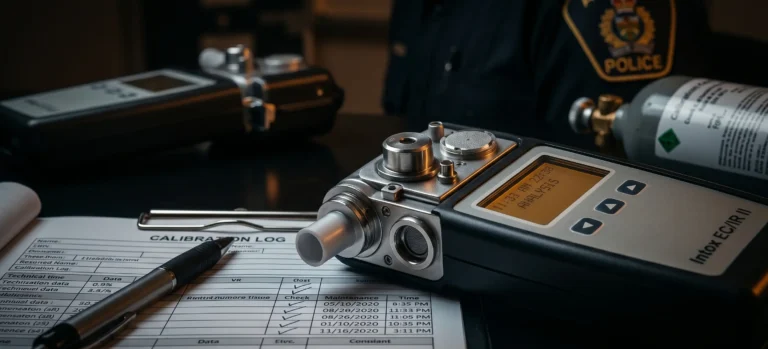
- Section 320.14(1)(b) — "Over 80." Having a blood alcohol concentration equal to or exceeding 80 mg of alcohol in 100 mL of blood within two hours of ceasing to operate a conveyance. Established by approved instrument analysis (the "Intoxilyzer 8000C") after a s. 320.28 demand.
- Section 320.14(1)(c) — Drug "over the limit." Having a blood drug concentration at or above the regulated threshold for the substance within two hours of operating — including THC (5 ng per mL of blood), cocaine, methamphetamine, ketamine, LSD, psilocybin, and other listed drugs.
- Section 320.14(1)(d) — Combined alcohol and drug. A combined blood alcohol concentration of 50 mg or more with a regulated drug concentration above the listed combined threshold.
- Section 320.14(4) — The lower drug threshold. A separate, less serious summary-conviction offence for a blood drug concentration in the lower regulated range — for THC, at least 2 ng but less than 5 ng per mL of blood — within two hours of operating. It carries a maximum fine of $1,000 and no mandatory minimum.
- Section 320.14(2) and (3) — Impaired operation causing bodily harm or death. The aggravated variants. Causing bodily harm carries a maximum of 14 years on indictment; causing death carries a maximum of life imprisonment.
- Section 320.15 — Failure or refusal to comply with a demand. Refusing or failing to comply with a lawful demand under s. 320.27 (screening) or s. 320.28 (approved instrument) is a stand-alone offence. It carries the same mandatory minimums as impaired operation itself. Refusing is not a way to avoid charges.
Mandatory Alcohol Screening (MAS) Under Section 320.27(2)
Since the December 2018 amendments under Bill C-46, Canadian police have had the power of mandatory alcohol screening. Under s. 320.27(2) of the Criminal Code, an officer who has in their possession an approved screening device may demand a breath sample from any driver they have lawfully stopped — without any prior reasonable suspicion of impairment. The driver's compliance is not optional. A failure or refusal to provide the sample is a criminal offence under s. 320.15.
MAS was constitutionally controversial when introduced and remains the subject of Charter litigation. Where the underlying traffic stop was itself arbitrary (no objective basis under R v Ladouceur or related authority), where the officer did not in fact have the device in immediate possession at the time of the demand (the Breault issue, discussed below), or where the screening device was not properly calibrated or maintained, the resulting evidence is reviewable.
The Immediacy Requirement After R v Breault, 2023 SCC 9
Section 320.27(1)(b) requires that a driver subject to a screening demand provide a breath sample "immediately." (The predecessor provision, the former s. 254(2)(b), used the word "forthwith"; the courts read the two terms the same way.) In R v Breault, 2023 SCC 9, the Supreme Court of Canada held unanimously that this immediacy requirement is strict. The officer must have immediate access to the approved screening device at the time the demand is made. Where the device is not on hand — being radio-requested from another unit, awaiting delivery to the scene, or simply not present — the demand is not valid.
The constitutional rationale flows directly from the right to counsel. The immediacy requirement is what justifies the limit on s. 10(b) Charter rights at the screening stage (the driver does not have the right to call a lawyer before providing the sample). If the demand is not actually immediate, that limit is no longer justified — and the demand cannot stand. Breault was decided under the former s. 254(2)(b), because the events predated the 2018 amendments, but the Court expressly held that its interpretation of the immediacy requirement applies equally to the word "immediately" in the current s. 320.27(1)(b). Where police did not have an approved screening device at the scene, where there was a delay between the demand and the device arriving, or where the time between the stop and the sample exceeded what could properly be called immediate, the Breault argument is available.
The Approved Instrument Demand — Section 320.28
Where the screening device produces a "Fail" reading, or where the officer otherwise has reasonable grounds to believe an impaired-operation offence has been committed, the next step is the approved instrument demand under s. 320.28. The driver is transported to a detachment, advised of the right to counsel, given an opportunity to consult counsel, and then required to provide two samples on the approved instrument (typically the Intoxilyzer 8000C). The samples must be taken at least 15 minutes apart. The lower of the two readings is the evidentiary BAC. The procedural framework — when rights to counsel are properly implemented under R v Brydges, [1990] 1 SCR 190 and R v Bartle, [1994] 3 SCR 173, when the qualified technician operating the instrument has done so in accordance with the Alcohol Test Committee operational procedures, and when the readings are properly admitted into evidence — is highly technical and the source of substantial defence-side work.
What the Crown Must Prove
For an impaired operation charge under s. 320.14(1)(a):
- Operation of a conveyance. The accused operated, or had care or control of, a motor vehicle, vessel, aircraft, or railway equipment.
- Impairment to any degree. The accused's ability to operate the conveyance was impaired by alcohol, drug, or both. The standard is "any degree of impairment" — not gross intoxication. R v Stellato, [1994] 2 SCR 478 remains the authority on the threshold.
For an "over 80" charge under s. 320.14(1)(b):
- Operation of a conveyance. Same as above.
- BAC at or above 80 mg/100 mL within two hours of ceasing to operate. Established by approved instrument analysis. The statutory presumption under s. 320.31 applies — readings produced by an approved instrument operated by a qualified technician in accordance with the regulations are presumed accurate, subject to challenge on specific evidentiary grounds.
- Two samples at the required interval. The samples must have been taken at the proper intervals, with the lower reading used.
For a refusal charge under s. 320.15: the Crown must prove a lawful demand was made, the accused understood the demand, and the accused failed or refused to comply without reasonable excuse.
The Technical Defences in an Impaired Driving File
Modern impaired driving files reward technical work on every step of the police procedure:
The lawful stop. Was the underlying traffic stop lawful? Random sobriety stops are authorized under R v Ladouceur, [1990] 1 SCR 1257, but the stop's purpose must be highway safety, not a pretext for an investigation outside the authority. Where the stop was effectively a pretext stop, where the detention extended beyond what the highway-safety purpose justified, or where the stop was based on unauthorized profiling factors, s. 9 of the Charter is engaged.
The screening demand and Breault. Was the ASD demand made when the officer had immediate access to a working device? Were the conditions for MAS (a lawful stop) properly met? Did the officer have a reasonable suspicion (where pre-MAS authority was relied on)? R v Breault, 2023 SCC 9 is the controlling authority on the immediacy requirement, and courts across Canada have applied it.
Reasonable grounds for the s. 320.28 demand. Did the officer have reasonable grounds to believe an impaired-operation offence had been committed before demanding samples on the approved instrument? Where the grounds were thin, where the officer's articulation of grounds in the disclosure is conclusory rather than fact-specific, or where the only basis for the s. 320.28 demand was an ASD reading that was itself reviewable, the demand can be challenged.
Right to counsel — sections 10(a) and 10(b). The right to be informed of the reasons for arrest, the right to retain and instruct counsel without delay, and the implementational duties under Brydges and Bartle all engage at the post-arrest stage. R v Suberu, 2009 SCC 33 governs the timing of the right to counsel. Statements obtained, or breath samples produced, in breach of s. 10(b) are exclusionable under s. 24(2). R v Grant, 2009 SCC 32 governs the analysis.
The intoxilyzer evidence. The s. 320.31 statutory presumption that approved-instrument readings are accurate is subject to specific evidentiary challenges — improper calibration, technician error, breaks in the chain of custody, or evidence that the instrument was malfunctioning at the relevant time. The Alcohol Test Committee's operational procedures and recommended standards are the benchmark; deviations are litigable.
The two-hour rule and the narrow intervening-drink defence. The 2018 amendments rewrote the "over 80" offence as having a prohibited BAC within two hours of ceasing to operate (s. 320.14(1)(b)). That reformulation deliberately eliminated the old "bolus drinking" defence — the argument that alcohol consumed just before driving had not yet been absorbed, so the BAC was below the limit at the wheel. Being under 80 at the moment of driving is no longer, on its own, a defence. The "intervening drink" defence — drinking after driving but before the test — now survives only within the narrow statutory exception in s. 320.14(5): the offence is not made out where the person consumed alcohol after ceasing to operate, had no reasonable expectation of being required to provide a sample, and the consumption is consistent with a BAC under 80 at the time of driving (with parallel exceptions for drugs in s. 320.14(6) and (7)). Toxicological evidence still matters, but it now does its work inside that constrained statutory frame rather than at large.
Care or control challenges. Where the accused was in or near a vehicle but not actively driving, the "care or control" element of s. 320.14 is contested. R v Boudreault, 2012 SCC 56 governs the analysis — care or control requires conduct creating a realistic risk that the accused would put the vehicle into motion. Where the accused had taken steps to ensure they would not drive (calling a ride, sleeping in a parked vehicle off a roadway), the element may not be made out.
Disclosure issues and delay. Modern impaired files involve voluminous disclosure — calibration certificates for the screening device, operational records for the approved instrument, body-worn camera footage, in-car video, and detachment recordings. Crown delays in producing complete disclosure engage R v Jordan, 2016 SCC 27.
Mandatory Penalties Under Section 320.19
Section 320.19 of the Criminal Code imposes mandatory minimum penalties on every conviction for impaired operation or refusal:
First offence — graduated by BAC.
- BAC under 120, or impaired without a BAC reading: minimum fine of $1,000;
- BAC 120 to 159 mg/100 mL: minimum fine of $1,500;
- BAC 160 mg/100 mL or higher: minimum fine of $2,000;
- Refusal to comply with a demand under s. 320.15: minimum fine of $2,000.
Second offence: minimum 30 days imprisonment.
Third or subsequent offence: minimum 120 days imprisonment.
The BAC-graduation of the first-offence fine matters. A BAC of 160 or higher at the first offence carries double the base fine and is treated more seriously by the sentencing court even where no custody is imposed. The fine is the floor — sentencing courts can and do impose higher fines, periods of probation, and (on the more aggravated first-offence files) short custodial sentences.
Mandatory Federal Driving Prohibition Under Section 320.24
A conviction under s. 320.14(1) (impaired operation, "over 80," or drug-impaired) or s. 320.15(1) (refusal) carries a mandatory federal driving prohibition under s. 320.24(1) of the Criminal Code. The minimum prohibition periods scale with the number of prior convictions: at least one year for a first offence, at least two years for a second, and at least three years for a third or subsequent. The prohibition prevents operation of a motor vehicle anywhere in Canada for the period imposed by the court.
For the aggravated variants — impaired operation or refusal causing bodily harm or death (s. 320.14(2)/(3), s. 320.15(2)/(3)), together with the related offences under s. 320.13 (dangerous operation), s. 320.16 (failure to stop), s. 320.17 (flight) and s. 320.18 — the driving prohibition is governed by s. 320.24(4) and is discretionary: the court may impose a prohibition, but the section sets no mandatory minimum for these offences. The federal prohibition is the first of the driving consequences that attach to an impaired conviction in Alberta. The provincial consequences under the Traffic Safety Act — the automatic disqualifications under s. 87, the alcohol-sensing-device requirement under s. 88.2, and the consecutive-stacking rule under s. 98 — are set out below.
The Provincial Driving Consequences Under the Traffic Safety Act — and the Consecutive Stacking Rule
Alongside the federal prohibition, Alberta's Traffic Safety Act layers on its own driving consequences. For impaired-driving files these come from two different provisions, and they operate differently depending on whether anyone was hurt.
For a conviction with no bodily harm or death — s. 320.14(1) (impaired, "over 80," or drug-impaired) or s. 320.15(1) (refusal) — there is no separate automatic provincial disqualification. Section 87 of the Traffic Safety Act does not list these offences. The only court-imposed driving prohibition for a basic impaired, "over 80," or refusal conviction is the federal one under s. 320.24, described above. What Alberta adds for these offences comes at the other end of the prohibition: the alcohol-sensing-device (ignition interlock) requirement under s. 88.2.
Section 88.2 — the interlock requirement on the way back. When the federal prohibition expires, a person convicted under s. 320.14 or s. 320.15 cannot simply resume driving. To have a licence reinstated, s. 88.2 requires participation in the alcohol-sensing-device program for a period that scales with the number of convictions: one year for a first conviction, three years for a second conviction within ten years, and five years for a third or subsequent conviction within ten years. For a conviction causing bodily harm or death (s. 320.14(2) or (3), s. 320.15(2) or (3)), the Registrar sets an interlock period of up to five years.
Section 87 — the automatic provincial disqualifications that do apply. Section 87 imposes automatic provincial disqualifications, taking effect on the day of the finding of guilt, for a different and more serious set of offences:
- Section 87(1) — one year. For dangerous operation (s. 320.13(1)), failure to stop after an accident (s. 320.16(1)), or flight from a peace officer (s. 320.17).
- Section 87(2) — five years. For the bodily-harm and death variants — dangerous operation, impaired operation, refusal, or failure to stop causing bodily harm or death (s. 320.13(2)/(3), s. 320.14(2)/(3), s. 320.15(2)/(3), s. 320.16(2)/(3)).
- Section 87(3) — five years. For criminal negligence causing death or bodily harm, or manslaughter (s. 220, s. 221, or s. 236), where the offence was committed by means of a motor vehicle.
These s. 87 disqualifications are automatic. They do not require a separate court order, and they take effect on the day of the finding of guilt, alongside the federal prohibition.
Section 98 — disqualifications run consecutively, not concurrently. This is the feature of the Alberta scheme that surprises most people. Section 98(1) provides that where a person is already disqualified from driving in Alberta and, during that period, becomes subject to a federal driving prohibition under s. 320.24 of the Criminal Code (or a further Alberta disqualification under s. 94), the new prohibition runs consecutively to any previous disqualification that is still in effect or waiting to take effect. Section 98(2) applies the same consecutive rule where a person already disqualified in Alberta becomes subject to a further Alberta disqualification.
The practical consequence shows up most often where an Immediate Roadside Sanction is already running. A person who received an IRS-FAIL for the same incident is serving an administrative disqualification under the Traffic Safety Act (a 90-day suspension, then a further period during which a restricted interlock licence is available). If that person is later convicted of the underlying criminal offence, the federal prohibition under s. 320.24 does not absorb into the IRS period — under s. 98(1), it runs consecutively, stacking on top. The two periods add together rather than overlap.
How the federal and provincial consequences interact in practice. For a basic impaired, "over 80," or refusal conviction with no prior active disqualification, the driving consequences are the federal s. 320.24 prohibition (at least one year on a first offence), followed by the s. 88.2 interlock requirement (at least one year) before a full licence is restored. Where an IRS or another disqualification is already active at the time of the finding of guilt, s. 98 makes the new prohibition run consecutively, so the total time off the road can be considerably longer than the federal prohibition figure standing alone suggests. Mapping out the real off-road period — the federal prohibition, the provincial disqualification where the offence is an aggravated or negligence offence, the interlock period, and any consecutive stacking — is one of the first things counsel does on these files.
Other Consequences — Insurance, Employment, and Travel
Beyond the criminal and licensing tracks, an impaired-driving conviction in Alberta produces a series of practical consequences that often have longer real-world impact than the custodial or fine sentence itself:
- Insurance. A criminal impaired-driving conviction moves most drivers from the standard insurance market into the Facility Association, with substantial premium increases for several years. Coverage costs of several thousand dollars annually are common during this period.
- Employment. Drivers in regulated commercial categories — Class 1, 2, 3, 4 — face loss of livelihood. Public-sector employment, vulnerable-sector roles, and any position requiring a clean criminal record are foreclosed.
- Interlock requirement. Alberta's Ignition Interlock Program is the standard pathway back to driving after the federal prohibition period. The program requires installation of an interlock device, ongoing maintenance and calibration fees, and adherence to a monitoring regime.
- United States travel. A criminal impaired-driving conviction renders a person inadmissible to the United States. A US entry waiver is the only remedy and must be applied for and renewed.
- Immigration consequences. For non-citizens, impaired driving is "serious criminality" under the Immigration and Refugee Protection Act because the offence carries a maximum of 10 years on indictment. Permanent residents face potential removal regardless of length of residence in Canada.
Where We Appear
We act on criminal impaired-driving files and SafeRoads IRS reviews in the Alberta Court of Justice, the Court of King's Bench of Alberta, and the Court of Appeal of Alberta, and before SafeRoads Alberta adjudicators on the administrative track. From our Calgary office we travel to court in Airdrie, Cochrane, Canmore, Okotoks, Diamond Valley, Didsbury, Strathmore, Drumheller, Hanna, Brooks, Medicine Hat, Lethbridge, Fort Macleod, Taber, Pincher Creek, and Cardston, and we appear in matters arising on the Tsuut'ina, Siksika, and Kainai (Blood Tribe) Nations.
If You Have Been Charged, Call a Lawyer Today.
Impaired-driving files reward early engagement on both tracks. The IRS review process runs on a strict 7-day deadline that does not move for the criminal court schedule. The criminal track produces voluminous technical disclosure — calibration certificates, video, intoxilyzer logs — that rewards careful review. The earlier counsel is involved, the more material there is to work with. The initial consultation is at no charge and is conducted in strict confidence.
If your matter is an IRS only, with no criminal charge: the path forward is set out on our SafeRoads Alberta IRS appeal page. The 7-day deadline for filing an IRS review starts on the date the IRS was issued.
Call us today at 587-583-2808
Strictly confidential. Initial consultation at no charge.
Impaired Driving Defence FAQ
How do I know if I've been criminally charged or only received an IRS?
The paperwork you received at the roadside tells you which track applies. An IRS Notice will say "Immediate Roadside Sanction" at the top and reference Alberta's Traffic Safety Act and the SafeRoads program — and will set out the 7-day deadline for filing a review. A criminal release document will reference the Criminal Code, will identify a section (most commonly s. 320.14 or s. 320.15), and will provide a court date. Many drivers receive both. Many receive only an IRS. The first conversation we have with new impaired-driving clients is about which path forward applies — IRS review only (covered in detail on our SafeRoads Alberta IRS appeal page), criminal defence only, or both in parallel.
Can I be charged even if I "felt fine" to drive?
Yes. Section 320.14(1)(b) of the Criminal Code — the "over 80" offence — is based on the breath sample reading alone: having a blood alcohol concentration at or over 80 mg within two hours of driving. Subjective belief that you were not impaired is not a defence to the per-se BAC offence. Section 320.14(1)(a) — impaired operation — is based on observed indicia of impairment on the totality of the evidence; subjective perception of one's own impairment is not the test there either. The same is true of an IRS-FAIL under the SafeRoads program.
What if I refused the breath test because I was scared or confused?
Refusing or failing to comply with a lawful demand under s. 320.27 (screening) or s. 320.28 (approved instrument) is a stand-alone offence under s. 320.15 of the Criminal Code. It carries the same mandatory minimum penalties as impaired operation itself. Refusal is not a way to avoid charges. The defence works on whether the demand was lawfully made — which engages R v Breault, 2023 SCC 9 (the device must have been on hand), the lawfulness of the underlying stop, and the proper articulation of grounds.
What is mandatory alcohol screening?
Mandatory alcohol screening, introduced in December 2018, gives police the power under s. 320.27(2) of the Criminal Code to demand a breath sample from any lawfully stopped driver — without any prior reasonable suspicion of impairment. The officer must have an approved screening device immediately on hand at the time of the demand. Where the underlying stop was unlawful, where the device was not in immediate possession, or where the device was not properly calibrated, the resulting screening evidence is reviewable.
What did R v Breault decide, and why does it matter?
R v Breault, 2023 SCC 9 is the Supreme Court of Canada's unanimous 2023 decision on the immediacy requirement in screening demands. The Court held that an officer must have immediate access to an approved screening device at the time the demand is made. Where the device was not on hand, where the officer was waiting for one to be brought to the scene, or where the time between demand and sample exceeded what could properly be called immediate, the demand is not valid. The decision was made under the former s. 254(2)(b), but the Court held that its interpretation applies equally to the word "immediately" in the current s. 320.27(1)(b), and courts across Canada have applied it.
Can drug use lead to impaired-driving charges in Alberta?
Yes. Section 320.14(1)(c) makes it an offence to operate with a blood-drug concentration at or above the regulated limit — for THC, 5 ng per mL of blood. A lower THC range — at least 2 ng but under 5 ng — is a separate, less serious summary-conviction offence under s. 320.14(4). Section 320.14(1)(d) covers combined alcohol-and-drug consumption. Police rely on roadside Standardized Field Sobriety Testing, Drug Recognition Expert evaluations, and oral fluid drug screening devices to establish grounds for the s. 320.28 blood-sample demand. The drug-impaired track is its own significant defence territory.
Can I avoid jail on a first-offence impaired driving conviction?
Usually, but not always. A first-offence conviction under s. 320.14(1) carries a mandatory minimum fine of $1,000 (or $1,500 to $2,000 at higher BAC readings or for refusal under s. 320.15) but no mandatory jail. Custody on a first offence is reserved for files with aggravating features — very high BAC readings, collision and injury, dangerous driving conduct in addition to impairment, or unusual fact patterns. Second and subsequent offences carry mandatory minimum custodial sentences (30 days for a second, 120 days for a third or subsequent).
Will I lose my licence if convicted?
Almost certainly, and the total can run longer than the federal figure alone suggests. For a basic impaired, "over 80," or refusal conviction, the court-imposed prohibition is the federal one under s. 320.24 of the Criminal Code — at least one year for a first offence, two years for a second, three years for a third or subsequent — and it applies anywhere in Canada. Alberta does not add a separate automatic disqualification for these offences under s. 87; instead, s. 88.2 of the Traffic Safety Act requires an ignition-interlock period before a full licence is restored (one year for a first conviction, three years for a second within ten years, five years for a third or subsequent within ten years). Where the conviction involves bodily harm or death, s. 87(2) adds a five-year provincial disqualification. And under s. 98, a new prohibition runs consecutively to any disqualification already in effect — including an active IRS-FAIL suspension — so the periods stack rather than overlap.
Do I need a lawyer for both the criminal charge and the IRS?
Where both tracks are running, yes — the criminal court and the SafeRoads adjudicator do not coordinate, do not share evidence in the same way, and apply different evidentiary standards. The 7-day IRS review deadline runs from the date the IRS was issued and does not move for the criminal court schedule. The strategic decisions on each track also affect each other — what is said in the IRS review can be relevant to the criminal proceeding, and vice versa. Where the matter is an IRS only with no criminal charge, the path is through SafeRoads Alberta only; details on the procedure, deadlines, and grounds for cancellation are on our SafeRoads Alberta IRS appeal page.
What does KJR Law charge to defend an impaired driving file?
Fees depend on whether the matter is criminal, IRS, or both, the volume of disclosure, whether a Charter application is brought, whether the file proceeds to trial, and whether expert evidence (toxicology, technical analysis of the instrument) is required. We set out our fee, disbursements, and GST in a written retainer letter before any work begins. The initial consultation is at no charge.
The First Conversation Is Free.
Impaired-driving files reward careful technical work on the police procedure, on the science of the breath or blood evidence, and on the Charter issues that attach to the stop, the demand, and the right to counsel. They also reward careful management of the parallel IRS administrative track where one applies. Early engagement gives counsel the time to review the disclosure carefully and to manage both tracks together.