
Robbery Charges in Alberta: What You're Actually Facing
Legal Review By: Brad Kraus, Criminal Defence Lawyer, KJR Law
Last Updated: June 7, 2026
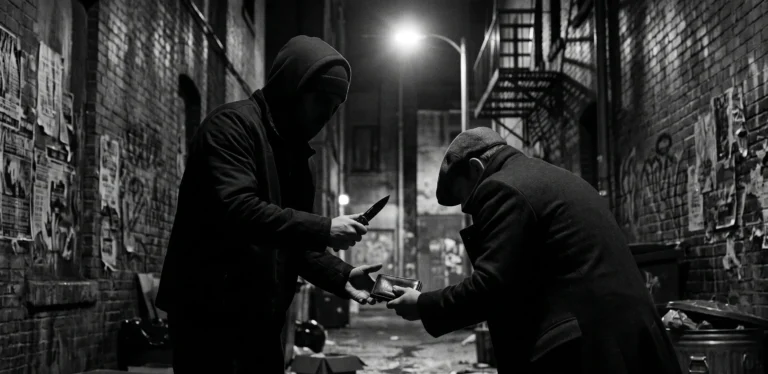
A charge under section 343 of the Criminal Code for robbery sits at the high end of property offending — closer to violent crime than to property crime, both in its statutory framing (life maximum across every variant) and in its sentencing practice. Robbery is theft accompanied by violence, threats of violence, or the use of a weapon. The Crown's case typically rests on identification, on the conduct alleged to have taken place at or before the moment of taking, and on whether any object used or displayed was a firearm, an imitation firearm, or some other offensive weapon.
This page explains the four modes of robbery under s. 343, the punishment structure under s. 344 — substantially restructured by Bill C-5 in 2022 and clarified by the Supreme Court of Canada in R v Hilbach, 2023 SCC 3 — the bail framework under the reverse-onus provisions of s. 515(6), the defences that operate in these files (identification, intent, imitation-weapon questions, party liability), and the sentencing reality after Hilbach. KJR Law represents people facing robbery charges across Calgary and Southern Alberta. Theft simpliciter is addressed on our theft defence page.
Do Not Give a Statement Before You Speak with a Lawyer
Robbery investigations move quickly at the front end. Where police identify a suspect, they will typically attempt an interview — at the scene, at the holding cells, or at the detachment — before counsel has been consulted. What is said in that interview frequently establishes the elements of the offence the Crown would otherwise have to prove circumstantially: that the accused was present, that the accused took property, that violence or a weapon was used or displayed, that the conduct was knowing and intentional. The right to remain silent under s. 7 of the Canadian Charter of Rights and Freedoms and the right to retain and instruct counsel without delay under s. 10(b) apply from the moment of detention. Call a lawyer first. There is no version of "telling police what happened" that improves the file in a robbery investigation.
The Four Modes of Robbery — Section 343
Section 343 of the Criminal Code defines robbery in four ways. The Crown can establish robbery by proving any one:
- Section 343(a) — theft using violence or threats of violence, to a person or property, to extort what is taken or to overcome resistance to the taking. The classic "stick-up" — the violence or threat is the means of accomplishing the theft, and it may be directed at a person or at property.
- Section 343(b) — theft accompanied by personal violence to the person robbed. Steals from a person and, at the time of the theft or immediately before or immediately after, wounds, beats, strikes, or uses any personal violence to that person.
- Section 343(c) — assault with intent to steal. Assaults a person with intent to steal from them, whether or not the theft is ultimately completed. Attempted robbery without weapon involvement frequently falls under this provision.
- Section 343(d) — theft while armed with an offensive weapon or imitation thereof. Steals from a person while armed with an offensive weapon or an imitation. Being armed is sufficient; this mode does not require that the weapon be used. Imitation firearms — realistic-looking replicas, BB guns, airsoft pieces — fall within this provision.
The line between modes matters. A theft accomplished by shoving a person to overcome their resistance engages (a); personal violence to the person being robbed engages (b). The display of an object the victim reasonably believes to be a firearm engages (d) even where the object is in fact a toy or imitation. But an imitation is not a "firearm": it does not trigger the s. 344(1)(a) firearm minimums, and an imitation-firearm robbery is punished under s. 344(1)(b) (no mandatory minimum), with a separate s. 85(2) count available. Charge selection on the Crown's part, and pre-trial work to disaggregate the file, both turn on a precise reading of which mode is in play.
Punishment Under Section 344 — After Bill C-5 and Hilbach
The s. 344 punishment framework was substantially restructured by Bill C-5 (S.C. 2022, c. 15) in November 2022. The four-year mandatory minimum for robbery with an ordinary firearm under former s. 344(1)(a.1) was repealed. The mandatory minimums for robbery with a restricted or prohibited firearm, or with any firearm in connection with a criminal organization, were retained. The Supreme Court of Canada in R v Hilbach, 2023 SCC 3 considered both provisions on s. 12 Charter challenge. Writing for the majority, Martin J. held that both the (then-)four-year minimum and the five-year minimum were constitutional. The remaining minimums under s. 344 are accordingly settled law.
Current penalty structure:
| Variant | Section | Mandatory Minimum | Maximum |
|---|---|---|---|
| Robbery with restricted or prohibited firearm, or any firearm in association with a criminal organization — first offence | s. 344(1)(a)(i) | 5 years | Life |
| Same as above — second or subsequent offence | s. 344(1)(a)(ii) | 7 years | Life |
| Robbery with an ordinary firearm (no criminal organization) | s. 344(1)(b) (formerly (a.1) — minimum repealed) | None (post Bill C-5) | Life |
| Robbery with no firearm | s. 344(1)(b) | None | Life |
Three points of practical importance:
- The "ordinary firearm" minimum is gone. The 2022 repeal of s. 344(1)(a.1) means a robbery committed with an ordinary firearm (long gun, non-restricted handgun, and the like), not in connection with a criminal organization, no longer carries a mandatory minimum. Both that variant and a robbery committed without any firearm now fall under s. 344(1)(b). Sentences in those files are set by reference to ordinary sentencing principles and the Alberta starting-point framework rather than by a statutory floor.
- The restricted/prohibited-firearm and criminal-organization minimums remain. Where the Crown can prove the firearm was restricted or prohibited (handguns are typically restricted; certain modified firearms are prohibited), or where the robbery is alleged to have been committed in connection with a criminal organization, the five-year (first) and seven-year (subsequent) minimums continue to apply. Hilbach upheld the five-year minimum under s. 344(1)(a)(i).
- Section 85 — using an imitation firearm. Section 85(1) (using a genuine firearm in the commission of an indictable offence) expressly excludes robbery from its scope: where a real firearm is used, the firearm consequences are carried by s. 344 itself, not by a separate s. 85 count. Section 85(2), which addresses the use of an imitation firearm, is not excluded — so where the object was an imitation, the Crown can lay a s. 85(2) count alongside the robbery. A s. 85 sentence is served consecutively to the sentence for the underlying offence (s. 85(4)); it carries a maximum of 14 years and, following Bill C-5, no mandatory minimum.
Alberta Sentencing — Starting Points and the Range
Robbery sentencing in Alberta operates under a starting-point framework established by the Court of Appeal of Alberta. The foundational decision is R v Johnas, 1982 ABCA 331, a five-judge panel that set a three-year starting point for unsophisticated robberies of unprotected commercial premises — the convenience-store and gas-bar cases — where a weapon was used and no victim was seriously harmed. The framework has been refined in subsequent decisions for armed robbery generally and for particular factual contexts. For home-invasion robbery, the Court of Appeal set a higher starting point of eight years in R v Matwiy, 1996 ABCA 63, applied to a mature offender with no prior record. Following R v Parranto, 2021 SCC 46 and R v Lacasse, 2015 SCC 64, a starting point is a guideline rather than a binding tariff, but the Court of Appeal continues to apply this framework.
From the starting point, sentences move up or down on the strength of:
- Aggravating factors: use of a firearm (especially restricted or prohibited), serious injury to a victim, planning and sophistication, targeting vulnerable victims, prior record (particularly for offences of violence), conduct during the offence (taunting, gratuitous violence), and breach of court orders at the time of the offence.
- Mitigating factors: youth, absence of prior record, genuine remorse, voluntary restitution, demonstrable rehabilitation, mental-health context, addiction context where treatment has been engaged, and Gladue factors for Indigenous accused.
Conditional sentences. Post-Bill C-5, the conditional sentence framework under s. 742.1 of the Criminal Code is more permissive than it was under the previous statutory bar, which had categorically excluded offences carrying a 14-year or life maximum. In robbery files where no mandatory minimum applies (that is, outside s. 344(1)(a) territory), a conditional sentence is not categorically barred. But two limits keep it narrow in practice: a conditional sentence cannot exceed two years less a day, and the Alberta starting points for armed and commercial robbery sit at or above three years. A conditional sentence is therefore realistically confined to the lowest-conduct files — typically first offenders where the fit sentence falls below the two-year ceiling — and remains subject to the community-safety analysis under s. 742.1(a) and the fundamental purpose and principles of sentencing in ss. 718–718.2. Whether it is available is fact-specific.
Bail in Robbery Files — The Reverse Onus Where a Firearm Is Alleged
Bail in robbery files is structured by s. 515 of the Criminal Code. For a robbery alleged to have been committed with a firearm, s. 515(6)(a)(vii) imposes a reverse onus: the accused must show cause why detention is not justified, rather than the Crown having to show cause why bail should be denied. (Other reverse-onus pathways may also apply — for example, where the alleged offence was committed while the accused was already on release.) This is a material procedural change, and the bail hearing is consequential.
Where bail is granted in a robbery file, standard conditions typically include:
- No contact with the alleged victim or witnesses;
- Geographic restrictions excluding the location of the alleged offence;
- Reporting conditions to a bail supervisor or peace officer, frequently several times per week;
- A specified residence and curfew, or in serious files, house arrest;
- A firearms prohibition;
- A prohibition on possessing imitation weapons, replicas, or any object that could be used or interpreted as a weapon;
- In some files, electronic monitoring on an ankle bracelet;
- Surrender of passport and travel restrictions.
Breach of any bail condition is itself an offence under s. 145 of the Criminal Code and typically results in custody pending trial. Where conditions are imposed that are overbroad or not properly connected to the alleged risk, a bail review under s. 520 of the Criminal Code is available.
The Defences That Operate in Robbery Files
Robbery files reward careful work on the elements of the offence and on the identification of the accused. The arguments that do the work in these files:
Mistaken identity. Robbery investigations frequently rest on surveillance footage, eyewitness identification, and dock identification at trial. Eyewitness identification is well-known to be unreliable, particularly where the incident was brief, the witness was under stress, the lighting was poor, or the offender was masked or partially concealed. The Supreme Court of Canada in R v Hay, 2013 SCC 61 confirmed the well-recognized frailties of in-court identification. The procedure used in any photo lineup or live lineup, the warnings given to the witness, and the manner of any in-court identification are all reviewable.
The "imitation weapon" question. Where the Crown alleges robbery under s. 343(d) on the strength of an imitation weapon, the issue is whether the object was an imitation of an offensive weapon and whether the surrounding circumstances bear that out. Where the object was concealed, where its appearance was ambiguous, or where the complainant's perception is open to challenge, the imitation-weapon element is contestable. As noted above, an imitation is not a firearm for the purpose of the s. 344(1)(a) minimums; on the same facts, the line between robbery under s. 343(d) and theft simpliciter can come down to this analysis.
No theft, or no intent to steal at the time of violence. Where the conduct alleged does not actually amount to theft (no property was taken, or what was taken was lawfully the accused's), the robbery falls. Where violence preceded any intention to steal — a fight that happened to occur near property, then a later separate taking — the temporal element of robbery may not be made out. The taking and the violence must be sufficiently connected in time and purpose.
Party liability under section 21. Where multiple participants are alleged — driver, lookout, principal — the Crown's case against each turns on s. 21 of the Criminal Code. Whether a party knew of the principal's intent to use a weapon, whether the principal's use of the weapon was a foreseeable consequence of the joint enterprise, and whether the party rendered actual assistance to the offence are all separately contestable. Reduction of liability from full robbery to aiding or abetting a lesser offence is a meaningful resolution path in appropriate multi-accused files.
Section 12 challenges — the remaining mandatory minimums. Following Hilbach, the Supreme Court of Canada has upheld the s. 344(1)(a)(i) minimum. The case-by-case framework from R v Hills, 2023 SCC 2 remains, and constitutional challenges on appropriate reasonable-hypothetical records are not foreclosed — but the analysis must work with Hilbach's reasoning, not around it.
Charter section 8 — unlawful search and seizure. Where police seized property, devices, or other evidence connecting the accused to the offence, the lawfulness of the search is reviewable. Warrants engage R v Garofoli; device searches engage R v Vu, 2013 SCC 60.
Charter section 9 — unlawful detention. Where the accused was detained on the street, at a vehicle stop, or through investigative procedures, the lawfulness of the detention engages s. 9. R v Mann, 2004 SCC 52 sets the framework for investigative detention.
Charter section 10 — right to counsel. Statements taken before the right to counsel was implemented, or where the implementation was deficient, are subject to exclusion under R v Grant, 2009 SCC 32.
Collateral Consequences
A robbery sentence is predominantly custodial, but a conviction reaches well beyond the custodial term. The consequences fall into two distinct groups, which are worth keeping separate: orders the sentencing court imposes as part of the sentence, and consequences the conviction triggers under other regimes the criminal court does not control.
Orders the court imposes (ancillary orders). These are part of the sentence itself. Each carries its own statutory test and is open to defence submissions at sentencing:
- A mandatory firearms prohibition under s. 109. On a first order, this prohibits ordinary firearms for a minimum of ten years (measured from release) and prohibits restricted and prohibited firearms for life; on a subsequent order, it is lifetime across the board.
- A DNA order under s. 487.051 — robbery is a primary designated offence, so the court orders a DNA sample on conviction.
- Restitution to the victim under s. 738, where the offence caused a quantifiable loss.
- The victim surcharge.
Consequences the conviction triggers elsewhere (non-penal). These flow from the conviction or the record but are not imposed by the criminal court and are not part of the sentence. They arise under other regimes, though their foreseeable severity can bear on the fitness of sentence:
- A permanent criminal record.
- Immigration jeopardy — a robbery conviction can constitute serious criminality under the Immigration and Refugee Protection Act, exposing a non-citizen to inadmissibility and removal.
- Professional and trade-licensing consequences.
- Travel and border consequences, including United States inadmissibility (robbery is treated as a crime involving moral turpitude).
Because these consequences differ in who imposes them and under what test, they are part of the resolution conversation from the first meeting.
Companion Charges
Robbery counts very rarely travel alone. Common companions:
- Section 85(2) — using an imitation firearm in the commission of an indictable offence. Served consecutively (s. 85(4)). Section 85(1), which covers genuine firearms, does not apply to robbery.
- Assault and assault causing bodily harm — ss. 265–268. Where the violence used during the robbery is also charged separately.
- Aggravated assault — s. 268. Where the conduct caused wounding, maiming, disfiguring, or endangering the life of the victim.
- Unlawful confinement / forcible confinement — s. 279. Where the accused detained the victim during or after the offence.
- Disguise with intent — s. 351(2). Where the accused was masked or disguised during the offence.
- Break and enter — s. 348. In home-invasion files.
- Possession of property obtained by crime — s. 354. Where the proceeds of the robbery were located in the accused's possession.
- Conspiracy — s. 465. In multi-participant files.
- Failure to comply — s. 145. Where the alleged conduct occurred while on a court order.
Where We Appear
We act on robbery files in the Alberta Court of Justice, the Court of King's Bench of Alberta, and the Court of Appeal of Alberta. From our Calgary office we travel to court in Airdrie, Cochrane, Canmore, Okotoks, Diamond Valley, Didsbury, Strathmore, Drumheller, Hanna, Brooks, Medicine Hat, Lethbridge, Fort Macleod, Taber, Pincher Creek, and Cardston, and we appear in matters arising on the Tsuut'ina, Siksika, and Kainai (Blood Tribe) Nations.
If You Have Been Charged with Robbery, Call a Lawyer Today.
Robbery files move quickly at the bail stage and reward early, careful work on identification, on the modes pleaded by the Crown, on the imitation-weapon and firearm-type questions, and on the Charter status of every search, detention, and statement that produced the disclosure.
Initial consultation at no charge. Scope is limited to an initial assessment of your matter and is subject to a conflict check. GST does not apply to a no-charge consultation.
Call us today at 587-583-2808
Strictly confidential. Initial consultation at no charge.
Robbery Defence FAQ
What's the difference between theft and robbery?
Theft, under s. 322 of the Criminal Code, is the fraudulent taking of property. Robbery, under s. 343, is theft accompanied by violence, threats of violence, or being armed with a weapon — real or imitation. The maximum for theft over $5,000 is ten years; the maximum for every variant of robbery is life imprisonment. Robbery is treated as a crime against the person, not against property, even though the underlying conduct involves a taking. Whether a file is charged as theft or as robbery frequently turns on whether any threat or violence was used, when, and connected to what.
Should I give the police a statement if they ask for my side?
As a general rule, no — not before you have spoken with a lawyer. Robbery investigations move quickly, and police often seek an interview before counsel has been consulted. What is said in that interview frequently supplies the elements the Crown would otherwise have to prove circumstantially: presence, the taking, that violence or a weapon was involved, and that the conduct was intentional. The right to remain silent under s. 7 of the Charter and the right to retain and instruct counsel under s. 10(b) apply from the moment of detention. You can decline to answer questions and ask to speak with a lawyer first.
Is it still robbery if no real weapon was used?
Yes. Robbery can be made out under several modes that do not require a real weapon: theft with violence or threats of violence (s. 343(a) and (b)), assault with intent to steal (s. 343(c)), and theft while armed with an imitation weapon (s. 343(d)). Under s. 343(d), the question is whether the object was an offensive weapon or an imitation of one, and whether the surrounding circumstances bear that out. Where the object was concealed or its appearance was ambiguous, the imitation-weapon element is contestable. An imitation, however, is not a "firearm," so it does not trigger the firearm mandatory minimums under s. 344(1)(a).
Is there still a mandatory minimum for robbery with a firearm?
It depends on the type of firearm and the context. The four-year mandatory minimum for robbery with an ordinary firearm under former s. 344(1)(a.1) was repealed by Bill C-5 in November 2022 and is no longer in force. The five-year minimum (first offence) and seven-year minimum (subsequent offence) for robbery with a restricted or prohibited firearm, or with any firearm in connection with a criminal organization, remain in force. The Supreme Court of Canada in R v Hilbach, 2023 SCC 3 upheld the constitutionality of the remaining minimums. Robbery with no firearm has no mandatory minimum and a life maximum.
What does R v Hilbach mean for robbery sentencing in Alberta?
Hilbach (2023 SCC 3) addressed s. 12 Charter challenges to the s. 344(1)(a)(i) and former (a.1) mandatory minimums. Writing for the majority, Martin J. held that both minimums were constitutional and that the threshold for striking down a mandatory minimum as cruel and unusual punishment is high. The practical consequence is that the remaining minimums under s. 344 — the five-year and seven-year minimums for restricted or prohibited firearm and criminal-organization robberies — are settled law for the foreseeable future. Constitutional challenges on appropriate factual records remain open, but must engage with Hilbach's reasoning.
What sentence am I actually looking at for robbery in Alberta?
Alberta uses a starting-point framework. For unsophisticated robberies of commercial premises — the convenience-store and gas-bar cases — where a weapon was used and no one was seriously hurt, the Court of Appeal set a three-year starting point in R v Johnas, 1982 ABCA 331. Home-invasion robbery carries a higher eight-year starting point under R v Matwiy, 1996 ABCA 63. A starting point is a guideline, not a fixed tariff: the actual sentence moves up or down on aggravating and mitigating factors — the type of weapon, injury, planning, prior record, remorse, rehabilitation, and Gladue factors for Indigenous accused.
Can I get a conditional sentence for robbery after Bill C-5?
It is not categorically barred, but it is narrow in practice. In files where no mandatory minimum applies — robbery without a firearm, or with an ordinary firearm not tied to a criminal organization — s. 742.1 can be engaged. Two limits keep it confined: a conditional sentence cannot exceed two years less a day, and the Alberta starting points for armed and commercial robbery sit at or above three years. A conditional sentence is therefore realistic only in the lowest-conduct files — typically first offenders where the fit sentence falls below the two-year ceiling — and remains subject to the community-safety analysis under s. 742.1(a) and the principles of sentencing in ss. 718–718.2.
How is bail handled in a robbery file?
Bail is structured by s. 515 of the Criminal Code. For a robbery alleged to have been committed with a firearm, s. 515(6)(a)(vii) imposes a reverse onus — the accused must show cause why detention is not justified, rather than the Crown showing cause for detention. Other reverse-onus pathways can also apply, for example where the alleged offence occurred while the accused was already on release. Where bail is granted, conditions are typically restrictive: no contact, geographic restrictions, reporting, residence and curfew, a firearms prohibition, and in some files electronic monitoring. A bail review under s. 520 is available where conditions are overbroad.
Can I be charged with robbery if I was only the driver or the lookout?
Possibly — under s. 21 of the Criminal Code, a person can be a party to robbery by aiding or abetting, not only as the principal. But the Crown must prove the case against each participant separately: whether the person knew of the principal's plan, whether they actually assisted or encouraged the offence, and, where a weapon was used, whether that use was a foreseeable consequence of the joint enterprise. These are distinct questions. In appropriate multi-accused files, reducing liability from full robbery to a lesser role or a lesser offence is a recognized resolution path.
What are the main defences in a robbery file?
The defences that recur: mistaken identity, often the central issue given the reliance on surveillance footage and eyewitness identification; imitation-weapon questions where the Crown alleges s. 343(d); absence of intent to steal at the time of the alleged violence; party-liability disaggregation under s. 21 in multi-accused files; Charter challenges to searches (s. 8), detentions (s. 9), and statements (s. 10); and, where applicable, s. 12 challenges to the remaining mandatory minimums. The work in any given file depends on the modes pleaded, the strength of the identification, and the Charter status of the investigation.
Will a robbery conviction affect my immigration status?
It can. A robbery conviction can amount to serious criminality under the Immigration and Refugee Protection Act, which for a permanent resident or foreign national can mean inadmissibility and removal from Canada. This is a consequence that flows from the conviction under a separate federal regime — it is not an order the criminal court makes — but its foreseeable severity can be relevant to the sentence the court imposes. If you are not a Canadian citizen, immigration exposure should be part of the conversation from the outset, alongside the criminal charge itself.
What does KJR Law charge to defend a robbery file?
Fees depend on the section and mode charged, whether a firearm or imitation is alleged, whether the file is multi-accused, the volume of disclosure, whether a Charter application is brought, whether the matter resolves before trial or proceeds to trial, and whether sentencing involves a constitutional challenge to a remaining mandatory minimum. We set out our fee, disbursements, and GST in a written retainer letter before any work begins. Initial consultation at no charge. Scope is limited to an initial assessment of your matter and is subject to a conflict check. GST does not apply to a no-charge consultation.